Featured

Effects of the Navies on the Civil War

The United States Civil War tore the nation apart and cost the lives of more Americans than all of its other conflicts combined. The Civil War has been studied by historians since its end in 1865 and still is an open topic for serious scholarship. The War Between the States has been seen as mostly a conflict on land. The naval aspects of the Civil War and their effects are a relatively neglected part of Civil War history.

While there are memorable naval events like the first battle between ironclad warships at the Battle of Hampton Roads in 1862, historians are divided on the effects of the Union and Confederate navies on the war. Historians, such as James M. McPherson in War on The Waters: The Union and Confederate Navies, 1861-1865, argues the naval portion of the war was crucial to the outcome to the conflict. Others, such as Craig L. Symonds in The Civil War at Sea, argue that Civil War navies had a lesser importance on the conflict, but did influence the military direction of the war.

The Union blockade attempted to cut off the trade of the Confederacy with seemingly mixed results. Many historians do not focus on the long-term effects of the Union blockade on the Confederacy. The historians that do, such as Stephen R. Wise in Lifeline of the Confederacy: Blockade Running During the Civil War argues that trade to Southern ports displayed a decline, but many blockade runners successfully skirted the Union patrolling ships and brought in vital supplies.

The Union blockade appears to have severely hurt the Confederacy and led to a spiral effect on the Civilian population and the overall Confederate war effort. Despite some military supplies that were brought in by blockade runners and great ingenuity by Southerners, nothing could overcome the loss of trade. The loss of imports may have led to shortages and a reliance on homespun manufacture. The is seems to have led to hunger, a decline in civilian morale, military desertions, and a reliance on an over-used railroad system. This spiral effect of the Union blockade on Confederate trade, economics, and the overall Confederate war effort can be seen as an area to focus on in this dissertation.       

Some research questions I would like to explore in my dissertation are: How important  were maritime aspects to the defeat of the Confederacy? How much of an impact did the Union navy’s blockade make on the Confederate war effort? How did the Union blockade effect the Confederacy’s  trade and economy? What freedom of action did Gideon Welles, as the Union Secretary of the Navy, and Stephen Mallory, as the Confederate Secretary of the Navy, have on planning and strategy?

At first, the research for this dissertation seemed to focus on military history. After some preliminary work, the questions that were raised with the effects of the blockade pointed to evidence in social history. The journals of Confederate women and men who lived through the war often refer to making due with shortages of many important necessary items such as clothing, food, and medicines. Research will tend to focus on these journals and diaries. Many of them were published as books. Some were also published in magazines. This dissertation will focus on trying to discover why so many staple items were in short supply and the efforts of the Confederate government to alleviate shortages and break the Union blockade with its own navy. Ersatz in the Confederacy by Mary E. Massey pointed out that severe deprivations occurred all over the Confederacy. Even things that were easy to obtain before the war, such as salt to preserve food, became difficult to obtain during the war. This dissertation will discover what were the causes of these deprivations and if the Union blockade of the Confederacy was a major factor.

Scholarship on this topic would span from economic history, social history, the history of technology, and military history. It would also include the overall trend of including race, class, and gender aspects into the research. Women ran the households while many men were off fighting. African-American men were conscripted and volunteered to be sailors in the Union Navy. In recent scholarship on the Civil War, historians have also argued for its inclusion as part of Atlantic History. The United States Civil War is not insulated from general trends in historical scholarship that include multiculturalism, diversity, and the conflict’s connections to Atlantic History. This trend can only strengthen my research about the conflict and highlight its multiracial and multicultural nature.

In conclusion, I would like to investigate naval aspects of the United States Civil War because I believe I have discovered a gap in the historical scholarship on the Civil War. Historians that discuss naval aspects of the war are mostly focused on military aspects the shortages of basic needs of people have been neglected. I plan to discover the long-term effects of the blockage and how important these effects were on the conflict. Primary sources will be utilized; but sources that illustrate the importance of race, class, and gender on the topic will also be used. The naval aspects of the Civil War will be evaluated as to their overall impact on Confederate economics, finance, and duration of the conflict.  

The Great Depression and the Investment Bubble

The Great Depression and the Investment Bubble

The causes of the Great Depression have been argued by scholars since the 1930’s. Not all agree on the causes. Most people who lived through that time period saw it as a combination of investment greed and the purchase of stocks by people who should not have been making that investment. It is possible to trace some of the economic events in the 1920’s to the Great Depression to these factors.

The first major factor was purchasing stocks, especially purchasing stocks on what is called speculation, or credit. Purchasing stocks in the 1990’s to 2020 has been a stable way to invest and has resulted in many stories of millionaires who invested in some startup company such as Apple Computers when they first started to offer stock. Now their shares are worth many, many times their initial investment.

Purchasing stocks are a risk, but many average people in the 1920’s did not know this. Some average people, who did not know how risky it actually was, were pulled in by slick stock brokers in the 1920’s. These salesmen told them about a new way to “get rich quick” which was purchasing stocks. All one had to do was to invest by picking a stock, then watch as the price went up. When the price went up, an investor earned money. It all seemed so easy.

Many people who had no business speculating in stocks were talked into investing their life savings into them. What they were hardly told, or perhaps they may not have understood, was that the most speculative stocks come with the highest risk. Risk is inherent in the stock market. If one does not have the financial capital to risk an investment, it should not be done.

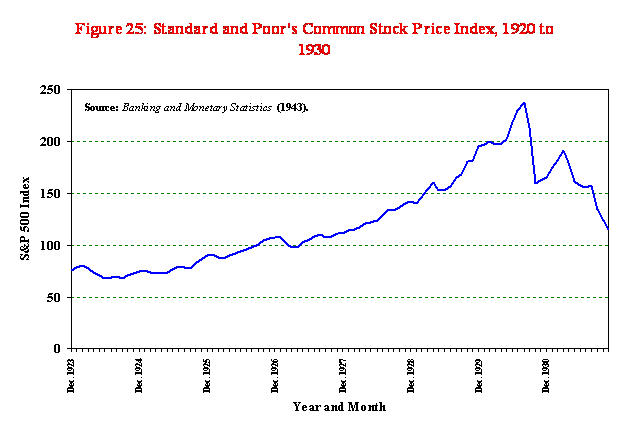
As the reader can see on the New York Stock Exchange graph from the Historical Statistics of the United States (1976), the common stocks (blue line) were rising at the same time the shares of stocks were being sold (black line). This means that the stocks were actually risky investments and being sold to other people who did not know of the risk. This is the famous “investment bubble.” Stocks are rising and continue to rise, but it is an illusion. At some point in time, brokers will not want to purchase the stock at the price which is asked.

Most of the risky speculation was taken by stock brokers who took the investment funds and usually purchased these risky common stocks. The broker had the license to purchase and sell stock, but could also arrange financing through speculation. This was the major problem. Speculation is financed through short-term loans from banks. Purchasing on speculation is 100% tied to the price of the stock increasing. The loan must be paid with the profits of the rising prick of the stock. If the price of a stock decreases, the loan still must be paid. Banks had made deals with brokers and also invested in stocks by financing speculation.

October 29, 1929 is known as “Black Tuesday”. This is the day that started a precipitous decling in the price of the inflated common stocks. On that day, the morning on Wall Street started normally. By noon when brokers tried to sell, they could find few buyers. Some brokers started to sell at a loss. Others saw the sales and started to sell their stocks at a loss also. Panic selling occurred on the usually busy New York Stock Exchange. The stock ticker could not keep up with the price of falling stock as many brokers sold stock for huge losses. By the end of the trading day on Wall Street, the overinflated stocks had lost much of their value and had returned to prices they were actually worth. Millions of people lost their life savings when the stock prices fell.

Banks called in their loans they made on the speculation. They found they stock brokers could not pay the loans. Banks lost much of their investors deposits when the loans they made to stock brokers could not be paid. This is how people said they, “lost all their their savings” by putting it in a supposedly safe place such as their local bank.

In this graph, one can see the large rise in “Bank Suspensions” from 1929-1930. These were the banks that were actually bankrupt and went out of business. A “suspension” means they suspend business because made too many risky loans that could not be paid back.

An oral history that this researcher did years ago, was to interview a relative named Clyde Bruner. He had been a young man during the Great Depression and remembered it well. He had many things to say about how the government handled the crisis, but his most harsh words were for the stockbrokers and bankers.

            “They were in cahoots together. They were all greedy and would help each other

             make money. They knew they didn’t have to repay the people whose money

             it was. Brokers would just say, “Oops, your money is all gone.” People never got

            their money from banks that went out of business either. People lost a lot of

            money in that d___ed Johnstown Bank. The bankers just locked the doors and

           that was the end of the bank. People sure didn’t get their money back from the  

            from brokers either. That was a good name for them, BROKErs.”  

In conclusion, the graphs are only a the graphic representation of the story of “get rich quick” schemes and the ability of salesmen to talk average working people into investing. The risky investments caused an investment bubble as many of the investments were 100% tied to the price of the stock increasing in value. People were hoodwinked into investing in the stockmarket in the guise that it was a safe, investment. In reality, any investment carries some risk. The investor who wishes to invest should do so wisely. The bursting of the huge investment bubble was a major cause of the greatest economic and social challenge to the citizens of the United States, the Great Depression.  

Bibliography

Bruner, Clyde. Personal communication. Johnstown, PA: July 5, 1982.

Rappoport, Peter and Eugene N. White. “Was the Crash of 1929 Expected?” American Economic           Review 84 (1994): 271-281.

Rappoport, Peter and Eugene N. White. “Was There a Bubble in the 1929 Stock Market?” The     Journal of Economic History 53 (1993): 549-574.

Romer, Christina. “The Great Crash and the Onset of the Great Depression.” Quarterly Journal    of Economics 105 (1990): 597-625.

Santoni, Gary and Gerald P. Dwyer, Jr. “The Great Bull Markets, 1924-1929 and 1982-1987:       Speculative Bubbles or Economic Fundamentals?” Federal Reserve Bank of St. Louis    Review 69 (1987): 16-29.

Santoni, Gary, and Gerald P. Dwyer, Jr. “Bubbles vs. Fundamentals: New Evidence from the       Great Bull Markets.” In Crises and Panics: The Lessons of History. Edited by Eugene N.        White. Homewood, IL: Dow Jones/Irwin, 1990.

Smiley, Gene, and Richard H. Keehn. “Margin Purchases, Brokers’ Loans and the Bull Market     of the Twenties.” Business and Economic History. 2d series. 17 (1988): 129-42.

United States Census Bureau. Historical Statistics of the United States: Colonial Times to 1970.    Last revised July 30, 2015.         https://www.census.gov/library/publications/1975/compendia/hist_stats_colonial-   1970.html

White, Eugene N. “The Stock Market Boom and Crash of 1929 Revisited.” The Journal of           Economic Perspectives. 4 (Spring 1990): 67-83.

White, Eugene N. “When the Ticker Ran Late: The Stock Market Boom and Crash of 1929.” In   Crises and Panics: The Lessons of History Edited by Eugene N. White. Homewood, IL: Dow Jones/Irwin, 1990.

Suffrage and Prohibition in Wyoming

Wyoming was admitted to the Union in on July 10, 1890 as the 44th state with the provision to allow women the right to vote. It was the first state to allow full women’s suffrage. The idea of women’s suffrage for the 1890 State of Wyoming was actually a holdover from the 1868 formation of the Territory of Wyoming.

The 1787 Northwest Ordnance set a minimum population of 5,000 free MALE inhabitants of legal age to be able to apply for Territory status. In 1868, the population was just about 5,000 free male inhabitants who were twenty-one years old or older, the legal age to vote. Wyoming had a large Native American population, but they were prohibited from voting.

An early map of the State of Wyoming

When the Wyoming Territory was formed in 1868, there were challenges that the new territory actually did not have the required number of free male citizens who were eligible to vote. The Territorial Assembly quickly passed the Women’s Suffrage Act. This allowed women the right to vote because of the low population in the Territory. According to the 1870 United States Federal Census, about 600 women were 21 years of age or older in Wyoming and were eligible to vote in elections. Wyoming has always struggled with a low population. Wyoming overcame the obstacles of low population by giving women the right to vote in order to be sure they had met the minimum population for a Territory. At the time, it was assumed that women would simply vote the way their husbands voted. THAT idea was wishful thinking! Since voting is by secret ballot, it is difficult to say if women actually voted the way their husband wished them to. When Wyoming became a state in 1890 the legislators insisted on keeping women’s suffrage to be sure to make the minimum 60,000 population. According to the 1890 US Federal Census, about 7,000 women in Wyoming were eligible to vote in the 1890 election. Wyoming still struggles with low population. It has the lowest population of any state. As of 2019, the population for the entire state is only 498,703.

Once women had the right to vote in Wyoming, some led the fight for national women’s suffrage and for Prohibition. Wyoming Women suffragists also helped to lead the fight for the 18th Amendment for Prohibition. There had been broad overlap before the Civil War among women supporting the abolition of slavery and those supporting women’s rights, by the late 1800s there was also a broad overlap among supporters of women’s rights and temperance supporters. As early as 1885, Wyoming’s Women’s Christian Temperance Union boasted at least four chapters, or unions, as they were called, around the state. By 1912, there were thirty-eight unions around the state. The Temperance movement just kept growing.

Wyoming had prominent advocates for national suffrage and temperance. One of these was Theresa Jenkins. Mrs. Jenkins was a prominent speaker at women’s suffrage meetings and a prominent member of the National American Woman’s Suffrage Association. NAWSA later became the League of Women Voters. She was also an advocate for the passage of the 18th Amendment which was ratified on January 16, 1919.

Wyoming also had the first woman governor of any state. Her name was Nellie Tayloe Ross. She had been the First Lady of Wyoming, but her husband unexpectedly died in office from complications of an Appendectomy. Ross won a special election to finish her late husband’s gubernatorial term and served from January 5, 1925 to January 3, 1927. As governor, she was an ardent supporter of Prohibition. She lost her bid for re-election in 1926, mainly because of her stance on Prohibition enforcement. After her governorship, Nellie Tayloe Ross became a leading supporter of presidential candidates such as Al Smith and Franklin Delano Roosevelt. She was appointed the first female Director of the United States Mint in 1933 by FDR. She remained in that post for twenty years!

Nellie Tayloe Ross

Prohibition was unpopular with Wyoming’s cowboy and ranching heritage. There were many acts of clandestine alcohol manufacturing. Lawmakers and sheriffs found Prohibition very difficult to enforce in such a large, rural state. There were also many accusations of sheriffs turning a blind eye to the illegal manufacture of alcohol.

The effects of Prohibition are still apparent in Wyoming. The Wyoming Liquor Division of the Department of Revenue tightly controls what types and varieties of alcohol that can be sold in the state. The State of Wyoming only issues a limited number of liquor licenses for businesses and liquor stores. Liquor can only be purchased at a business or a package liquor store. A finite number of liquor licenses are granted to each municipality based on population. New businesses cannot obtain a liquor license unless a business that already holds one surrenders theirs!

Bibliography

Gordon, Elizabeth P. Women Torch-Bearers: The Story of the Woman’s Christian Temperance Union. 1924. Archive.org, Accessed December 4, 2019. https://archive.org/stream/womentorchbearer00gord/womentorchbearer00gord_djvu.txt.

Rea, Tom. Booze, Cops, and Bootleggers: Enforcing Prohibition in Central Wyoming. Accessed December 4, 2019. https://www.wyohistory.org/encyclopedia/booze-cops-and-bootleggers-enforcing-prohibition-central-wyoming.

The Laramie Republican, Nov. 12, 1919. http://newspapers.wyo.gov. Accessed December 5, 2019.

United State Census Bureau. 1870 Census: Volume 2. The Vital Statistics of the United States. 1872. Accessed December 4, 2019.

United States Census Bureau. “Census of Population and Housing, 1890,” Accessed December 4, 2019.

Wyoming Ratifies the 19th Amendment. https://www.wyohistory.org/encyclopedia/wyoming-ratifies-19th-amendment. Accessed December 4, 2019.

Wyoming State Tribune, Jan. 27, 1920, Jan. 28, 1920, Jan. 29, 1920. https://newspapers.wyo.gov/home. Accessed December 4, 2019.

From Heavy Industry to the Service Industry – Two States

a) Introduction of the topic

The post World War II featured heavy industry such as steel mills and manufacturing plants as a major support of the economy in some states. When these industries declined, there were major ramifications to the population and to the economies of the states that contained these industries. Places such as the Gary, Indiana area and Buffalo, New York area relied on heavy industry as a backbone to their economy.  Large steelmaking corporations such as United States Steel and Bethlehem Steel were major employers in these areas. Bethlehem Steel operated major steel mills in Lackawanna, New York and Burns Harbor, Indiana. Unites States Steel also had major mills in Buffalo and Gary, Indiana.

These steelmaking giants started to lose money and did not reinvest profits into their plants. They relied on old technology such as Basic Oxygen Furnaces to make their products. When these industries continued to decline, layoffs occurred that swelled the local numbers of unemployed workers. When these steel companies eventually shuttered unprofitable steel mills, their managers and workers found themselves unemployed. Like many other large industries, there are support businesses and jobs such as welders, machine operators, truck drivers, and railway personnel that  also became unemployed.

The local unemployment rates increased dramatically as workers reacted to the shock of these companies and their spinoff industries going out of business. These workers spent a period of time getting retrained from the U.S. Department of Labors Trade Act Program to reenter the job market.

b) Extended explanation of chosen research methodology and sources and why they are appropriate to this comparison. 

In the two states chosen for comparison, a regression model on labor statistics for both states show a fairly large spike in the unemployment rate that lasts for years. This spike is evident in the historic labor statistics. The unemployment rate is high as displaced workers are being retrained to be able to reenter the workforce with new skills. The Federal Trade Act Programs offered assistance to displaced workers at trade schools and colleges to get new training for future employment.  When Quantitative analysis of historic labor department  data is used from both states and the U.S. Department of Labor, the data shows the historic time in the early 1980’s to 1990 when the economy in both of the states was undergoing a fundamental change from heavy industry to the service industry.

In both states, the data shows a spike in unemployment for a few years, then an eventual reduction in unemployment rate. The data also shows a growth of the workforce as the economies in both states rebound.  The data shows the displaced workers from heavy industry and manufacturing are eventually reentering the workforce to fill new jobs that are being created. The United States Department of Labor’s Trade Act Programs supplied tuition assistance for trade schools and colleges for displaced workers who were not of retirement age to learn new skills to reenter the workforce in different careers.

c) Analytical comparison of the two examples in terms of economic conditions.

The heavy industry and manufacturing sectors in northern Indiana and upstate New York showed similar downturns at the same time. Heavy industry and manufacturing declined in both areas; it led to a surge in unemployment. This is seen in the historical labor department data for both states. What is also apparent is the eventual economic recovery of both states as displaced workers were retrained in new skills to perform new jobs.

One may question if the reduction in unemployment and the growth of each states

d) Concluding statement summarizing the study’s findings. 

The same unemployment spikes were seen in both states at the same time as their economies changed from heavy industry and manufacturing to the service industry and technology jobs. What is also interesting is that the data shows the eventual successful reintegration of displaced workers back into the workforce with new skills as both states show a steady decline in unemployment and and a surge in job creation.

One may question if the reduction of unemployment and the upsurge in the creation of new jobs correlates to the retraining of displaced workers. This is a fair question. Demographics of the areas of both states are similar. Northern Indiana and upstate New York have similar demographics. They are areas that were both losing population and the population that remained is aging. Demographics show that the population has since stabilized in both these areas as the change in the economies from heavy industry to the service industry was completed. The Federal Trade Act Programs helped to retrain the displaced workforce that was not of retirement age in those areas.

Bibliography and data sites

Indiana Department of Labor.  Indiana Dept of Labor: Home

Indiana Department of Labor Historic Occupational Employment Statistics. Indiana – May 2019 OES State Occupational Employment and Wage Estimates

New York State Department of Labor.  Department of Labor Home Page | Department of Labor

New York State Population Survey. NYS current_pop_survey_data.pdf

United States Bureau of Labor Statistics data.  Bureau of Labor Statistics Data

United States Bureau of the Census, New York 1980. https://www2.census.gov/prod2/decennial/documents/1980/1980censusofpopu80134unse_bw.pdf

United States Bureau of the Census, New York 1990. https://www2.census.gov/library/publications/decennial/1990/cp-1/cp-1-34-1.pdf

United States Bureau of the Census, Indiana 1980. https://www2.census.gov/prod2/decennial/documents/1980/1980censusofpopu8011u_bw.pdf

United States Bureau of the Census, Indiana 1990. https://www2.census.gov/library/publications/decennial/1990/cp-1/cp-1-16.pdf 

United States Department of Labor Trade Act Programs. https://www.dol.gov/general/topic/training/tradeact 

United States GDP by year compared to recessions and events. US GDP by Year Compared to Recessions

and Events

United States Real GDP Growth Rate by Year.   U.S. Real GDP Growth Rate by Year: Inflation, Unemployment